===============SRO
News=================

2004/05/10
--
One
day after it's closest approach to Earth,
comet
C/2001 Q4 NEAT was shown to have much
activity in it's coma. A number of tail and shell features are apparent.
2004/03/21
--
The
FOFU group has made their first asteroid discovery
from Stony Ridge, a 19th magnitude main-belt object, while making
observations of Near-Earth objects.
2003/06/01
--
Pam
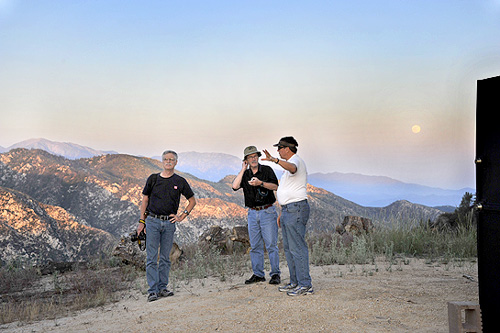
Sable, Dave Hadlen and Steve Brewster exercised
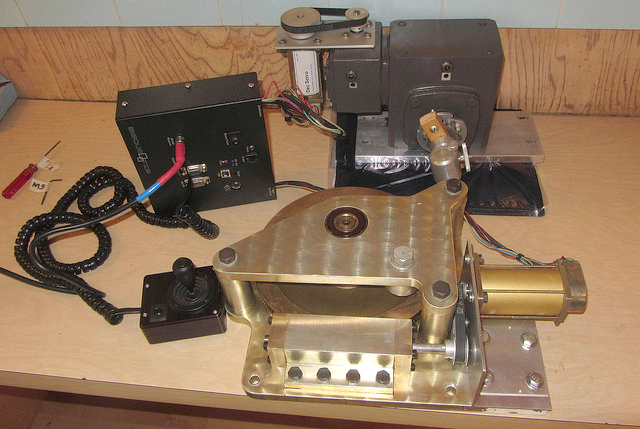
the new camera mount built by
Tim Cann. The mount is comprised of old and new Stony Ridge equipment.
Click on this image of M101, a.k.a. Arp 26 to see it full size.
2003/02/09
--
Members of SRO's asteroid project (FOFU) utilized the new Stony Ridge
camera equipment acquired through generous grants from Dr. E.F. Helin
and World Space Foundation to image the faintest targets yet achieved
at the observatory. Of the 20 asteroids observed:
2
were fainter than visual magnitude 21, about one million times fainter
than can be detected by human eyes without help from telescope and
camera.
2
were confirming observations of new discoveries from NEAT,
NASA/JPL's Near Earth Asteroid Tracking program.
3
are called Virtual Impactors (VI), asteroids that show a very small
chance of impacting Earth in the future using current observations.
Usually these objects are removed from the VI list after more observations
are made. 2 of these objects have now been removed from the VI list.
1
object, 2003 BK47, still remains on the VI list (as of 2003-02-13),
with a 1 in 1.4 million chance of impacting the Earth within the time
period between 2020 and 2102. As of 2003-02-13 the observations from
Stony Ridge are the last observations made of this object.
1
object that we call SRO 0303 is a newly discovered asteroid! However,
since we managed
only to
observe the object on this one night, it will probably be lost, at
least for now. FOFU's observations of SRO 0303 get thrown onto a heap
of asteroid observations at the Havard-Smithsonian Minor Planet Center
(MPC) known as "one night stands" that await further confirming
observations. One criteria for receiving discovery credit for an asteroid
observation is that the object be observed over several days. Someday,
somewhere, someone may observe this object again and report its position
to the MPC and perhaps those observations can be linked to ours.
During
our asteroid observations, we happened to acquire images of a barred-spiral
galaxy called NGC 3887 that one can view
on our Deep Sky page. Considering the image was exposed for only 9
minutes, it shows considerable detail. Seeing conditions were very
good, showing faint stars at 2.5 arc-second resolution.
2002/12/08
--
FOFU
observations of 2 objects, both Virtual Impactors that were soon removed
from
the VI list. Both were observed at fainter than 19th magnitude with
30-second exposures. We also made a "pretty picture" of
the Orion Nebula illustrating the wide dynamic
range of the capable AP8p camera.
2002/11/24
--
First
FOFU observations since September - Observations were made of only
1 object, an important one though. These observations of 2002 VU94
allowed this object to be excluded from the Virtual Impactor list.
This
object was the first asteroid imaged with our new camera system.
2002/10/08
--
We
have received our new Apogee AP8p camera and photometric filters as
a result of the generous donation from Dr. Eleanor F. Helin. Engineering
and testing on the new equipment now begins.
2002/09/08
--
FOFU
observations were made through smoke and falling
ash from the fire to
the east.
The fire closed the
Angeles National
Forest for two months.
No further observations could be made after this run until November
(see story). Despite
this regrettable event, we had a very productive night making dozens
of observations of six objects, 3 Amor type asteroids, 1 Mars-approaching
asteroid, 1 main-belt asteroid and 1 unusual Damocloid type object.
2002/09/01
--
FOFU
observations were canceled due to a wild fire in the San Gabriel River
Canyon to the east of the observatory. The fire closed the road to
Stony Ridge.
2002/08/12
--
SRO
has received a very generous donation from Dr. Eleanor F. Helin to
fund the purchase of a large-chip, back-illuminated CCD camera with
photometric filters. The camera will be used by FOFU to enable follow-up
and confirmation of small bodied solar system objects fainter than
magnitude 20 V. The wider field of view of such a camera will also
help ensure detection of newly discovered objects with higher ephemeris
uncertainties.
2002/08/01
-- Tim
Cann brought an SBIG ST1001E camera to the observatory to evaluate
the flatness of the focal plane of the 0.76-m telescope in regards
to utilizing a camera with
a larger sensor area. The results were quite good with images of M-27
and M-14. The image taken of M-14 is the best image
of this object that I've ever seen.
2002/07/24
--
The Planetary Society
announced its 2002 recipients for the Eugene Shoemaker NEA Studies
Grant. Stony Ridge's proposal was not selected. Our proposal was strong
and all the folks that were involved deserve our praise. The members
of the group included John Rogers, Steve Brewster, Sara Martin, Pam
Sable, Karen Davis, and Dave Hadlen. Information about the wining
proposals are on the Planetary
Society's web site.
2002/05/18
--
From
NPR News, it's All Things Considered. Travel
to the top of Mauna Kea in Hawaii to visit with astronomer Dave Tholen
as he describes his work tracking near-Earth asteroids. The type of
work Dr. Tholen describes is exactly what SRO's Faint Object Follow
Up (FOFU) is involved with, following faint objects that may pose
a threat to Earth in the future. (The link above will download a Real
Audio interview from www.npr.org.)
2002/05/15
-- Two
potentially hazardous asteroids (PHAs) were imaged at Stony Ridge
and valuable astrometry was provided to the Minor Planet Center in
Cambridge.
One
object, designated 2002 OG5, was added to the list
of "Virtual Impactors" (VI) -- objects whose observations
produce virtual Earth-impact orbital solutions that fit the current
observations. Generally
these objects get bumped off the VI list when follow up observations
are reported.
Soon
after our observations were reported, OG5's VI status was,
indeed, put to rest.
The
other PHA observations were made of 2002 JZ8.
This
image (right) is a composite of three images stacked together and
aligned on the asteroid.
This gives the appearance that the asteroid is still, and the stars
are moving, the opposite of the truth. In this way, we are able to
see the asteroid 3 times brighter than it really is, compared to the
stars.
Update on
2002 GZ8: (see 2002/04/14):
According to the NEODyS group in Italy, all virtual impact trajectories
for GZ8 have been resolved by follow up observations from
Stony Ridge Observatory and 11 other observatories
Update
on 2001 SB170
(see
2001/09/23
and 2002/02/21 below): As reported by NEODyS, this stadium sized boulder
was indeed a difficult object to observe. Sufficient follow up observations
to prevent it from being lost were not successful. By the time SB170
encounters Earth again and becomes bright enough to be detected, the
high uncertainty of its position means that it will have to be rediscovered
anew. Observations of SB170 from
Stony Ridge Observatory were the only observations made by any amateur
astronomers worldwide. SB170 was followed
by professionals at LINEAR, Klet, Ondrejov, National
Research Council of Canada and LPL/Spacewatch II. It was last detected
on October 13, 2001 by Spacewatch II in Arizona.
2002/04/14
-- This image was taken during the Faint
Object Follow Up program at Stony Ridge Observatory to confirm a newly
discovered fast-moving object (FMO) now designated as 2002 GZ8.
Details of the discovery and confirming observations were published
on MPEC
2002-G69.
Its very faint trail is indicated by tick marks on the image.
GZ8
was
discovered at MIT's Lincoln Near-Earth Asteroid Research (LINEAR)
telescope in New Mexico on April 12th and confirmed at Powell
Observatory on April 13, and Stony Ridge Observatory on April
14. Later observations were submitted from the Desert Moon Observatory
in New Mexico and by Stephen Laurie of Church Stretton in the U.K.
With these observations an orbit was determined by the Minor Planet
Center indicating the object to be a potentially hazardous Earth-crossing
variety. Using the same data, JPL/SENTRY
and NEODyS
determined that there were some very small but non-zero chances of
GZ8 impacting on Earth in the future. Impact alerts such
as these are usually discounted after more observations are received
over time and more accurate orbital elements are determined that eliminate
the impact solutions.
An
unknown object that was moving MUCH faster than GZ8 is
marked with an arrow in the picture above. During the 120 seconds
it took to make the image, GZ8's image trailed about 5 arc-seconds,
while the fast moving object (FMO) trailed at least 90 arc-seconds
before it left the field of view (if going to the left), or before
the camera shutter closed (if heading to the right). Because both
ends of the trail did not show in the image, it was impossible to
determine an essential parameter for follow up observations, the speed
of the object's travel. This is one discovery that got away! It appears
to be a real object, but the answer to whether or not it is artificial
(a satellite or orbital debris) or natural (a very near-Earth asteroid)
remains lost forever.
We
successfully confirmed another asteroid discovery on this night. 2002
GM9 is an Amor (Mars crossing) type discovered by NEAT
on April 12. This object represents one of the faintest confirmations
we've made at Stony Ridge Observatory. It was observed at red magnitude
20.3 (compared to R=18.6 for GZ8 above!). Discovery and
confirmation observations were reported on MPEC
2002-H02.
2002/04/12
-- Stony Ridge Observatory was host to about
20 students from University of La Verne (CA). Students and
visitors got their first glimpses of Jupiter's Red Spot, and
its moons Io, Europa, Ganymede and Callisto, an open star cluster
called M-67, and a planetary nebula named NGC 2438,
the last gasp of a dying star.
2002/02/21
-- The faint virtual impactor 2001 SB170
was observed at SRO on one night last September (see 2001/09/23 below).
Because of its faintness, this object has proven to be a difficult
one to follow even with large professional telescopes. This is a good
example of why it is so important to get quality observations of faint
asteroids soon after their discovery.
As
noted from the Spaceguard
Monthly Monitor - December 2001:
"The
case of 2001 SB170 (H = 22.9) is not completely solved yet, despite
the observations made by the Spacewatch-II program when the object
was around magnitude 23. Further observations, taken on October
21 at the European Southern Observatory, need to be analyzed. With
the data available so far all the collision solutions but one were
removed. Whether or not more data from ESO becomes available in
the near future, this has been one of the most difficult objects
to follow given the circumstances of the apparition and the information
available (poor initial magnitudes). "
For those of you with curiousity, the "virtual
impact" status/date to be resolved in the question above is
March, 2078. Details can be read on the Spaceguard site.
2002/02/03
-- Observations
of SN 2002ap from SRO were made
and magnitudes reported to AAVSO.
2002/02/02
-- An example of how
seeing conditions at SRO affect image quality is now on line.
2002/01/30
-- Unusual
supernova
discovery in M74, SRO begins participation in an international
effort to provide photometric data. Breaking
news from S. Kulkarni and E. Berger from Caltech... and more info
and images from Japan.
2001/12/09
-- FOFU observed a number of interesting
asteroids, including the fast-moving object (FMO) 1998 WT24.
The image to the right is a composite of four images of WT24
showing its path among the stars. (see Asteroid
Observations.)
2001/10/27-28
-- After 20 years we finally applied a new paint
job to the dome - all the way to the top. Here is a short
photo essay of the event.
2001/09/23
-- 2001 SB170
The
FOFU group has successfully made confirming observations of an Apollo
type (Earth crossing) asteroid. Details may be viewed from the Asteroid
page for the object designated as 2001 SB170.
The
image is a composite of two 2-minute exposures showing the trail of
the very faint asteroid which was moving across the sky at 2.5 degrees
per day. This interesting object warrants further observations and
FOFU will continue observations until it
fades below the detection limit of the 30-inch telescope.
2001/08/19
--
Some recent images of Uranus,
M-16 and M-71
have been added to the Image Gallery.
2001/08/01
--
A photograph taken of the faint planetary nebula, Abell
12, taken by Mike O'Neal in 1986 has been added to the image
gallery. This might make a challenging CCD target this winter.
2001/07/21-22
-- Four targets were imaged for FOFU, one of which,
2001 OE13 turned out to be a Main-belt asteroid.
We also performed follow up observations on the Apollo-type object
designated 2001 ND13 recently discovered by NEAT.
An oddball as far as asteroids go, 2001
OK17 is a Mars-approaching asteroid with unusually
high eccentricity and inclination. The orbit
animation shows that OK17 can make close approaches
to Jupiter.
A
"discovery" of a high proper motion
star was made while taking images of Comet
2001 A2 LINEAR on the same night.
2001/06/23-24
-- An all-night FOFU effort successfully tracked the
Palomar/NEAT object designated 2001 MS3.
All astrometric measures of Near-Earth Objects (NEO) from Stony Ridge
Observatory are published on the NEO
Dys site.